A career in racing can look very appealing for young people brought up on the sociable nature of spectating at our more glamourous racing fixtures. If you’ve been involved with horses, enjoy the cut and thrust of business, the excitement of live broadcast or the maths behind bookmaking, racing offers a wide variety of fulfilling roles.
Youngsters looking to get into the racing game can find lots of entry points nowadays in a way that has developed considerably over 40 years. But it’s still a quite bewildering process, and one where qualifications push you into the orbit of decision-makers and AI bots to get you that first interview.
School leaver roles for aspiring British horsemen
Inevitably, the easiest route is through handling the horses themselves; there is a constant stream of roles advertised in Careers in Racing for competent horsemen and women willing to manage the unsociable hours of stable work for the rewards of camaraderie and a rural vocation.
For aspirant jockeys, a job in yards is guaranteed for graduates from the British Racing School in Newmarket and National Racing College in Doncaster through their Foundation, Diploma and Stable Staff courses.

BRS courses range from teaching you to ride to management courses
B R S in particular have expanded their course portfolio to prepare middle and junior managers for roles within racing’s career structure. From a one week introductory course to British racing to a two year Horseracing Industry BSc in partnership with Hartpury University, the scope for school leavers to make themselves recruitable is considerable.
The Royal Agricultural University at Cirencester runs a 3 year course in Bloodstock & Equine Performance Management catering for those seeking roles across racing and equestrian sport at large.
Graduate Schemes
Administrative and management roles in racing are somewhat harder to come by, and the industry tends to appeal to self-starters who are articulate, promote themselves and engage pro-actively. There’ll always be room for self-starters who can talk.
Most of the developed racing nations have some sort of graduate entry scheme.
UK
The BHA Horseracing Development Programme has been running for some 20 years, and includes alumni like Adam Waterworth, MD of Goodwood Racecourse, and Jeremy Martin, Clerk and CEO at Salisbury.
Catering for honours degree graduates and higher apprenticeships, the 10 week course begins with a fortnight’s residential course at the Racing School in Newmarket before industry placements across sales companies, racecourses, Weatherbys and in BHA’s HQ at High Holborn.
Liverpool University’s MBA in Business Administration in the Thoroughbred Horseracing Industry is a 2 year course which graduates are expected to join in conjunction with a full- or part-time role.
Graduates of these courses find their way into stud manager roles, or in training yards, supported by work placements during the course.
Ireland
You’d expect the heartland of racing to promote its own career ladder, and they’re not found wanting.
The Thoroughbred Breeding Management course at the Irish National Stud in Kildare, Ireland, is a six-month residential program that runs from mid-January to late June, coinciding with the Northern Hemisphere breeding season. It combines practical, hands-on experience with lectures and industry visits, giving students a comprehensive understanding of thoroughbred breeding and management.
Graduates of the course receive a Certificate of Thoroughbred Management.
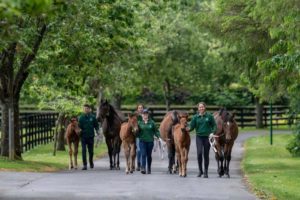
The short course at the Irish National Stud is well regarded and a passport to work in Irish racing
Horseracing Ireland also has its own graduate scheme, a 2 year course with on-the-job training. The course preps successful candidates for roles in operations, marketing, finance and event management.
Godolphin’s Flying Start is the blue riband of the grad schemes, offering successful candidates a fast-track to premium roles in the sector. The two-year, full-time programme combines academic learning, practical horsemanship, and leadership training to prepare participants for management roles in the Thoroughbred industry, with placements in Ireland, at Newmarket, in the USA, Australia, and the Middle East.
Rare among these schemes, GFS is fully funded, insofar as the elite 12 graduates each year are paid. I’ve yet to meet a graduate whose career and life was not enriched by the experience.
Australia
Recognition of the need to create career pathways, Australian racing has followed BHA’s lead.
Thoroughbred Breeders Australia (TBA) launched a new graduate program in 2024, creating a unique pathway for young talent to enter the thoroughbred industry. This initiative offers university graduates an immersive experience, featuring guidance from top figures in racing, breeding, and wagering. Participants begin with an intensive two-week course at Flemington Racecourse, followed by a 6 week paid internship with a leading employer in the industry. The scheme, limited to 12 applicants each year, enjoys a 90% employment success rate within the sport.

Australia’s T B A course is restricted to 12 each year
Hong Kong
The world’s most successful racing jurisdiction has a highly developed industry training ladder under the title of the Racing Talent Training Centre.
Split into two separate schools, the Apprentice Jockey’s School, launched in 1972, focuses on nurturing and developing riding talent, whether for fully fledged professional jockeys or for other ancillary horsemen roles.
There are further courses designed for other hands-on roles in the sport – farriery, assistant trainer and stewarding.
U S A
Bluegrass country in Kentucky is the epicentre for thoroughbred breeding in the United States. No surprise then that Kentucky University espouses a Racecourse Management Certificate, but this is a turf management course, designed for groundstaff with a view to improving the quality and consistency of the turf racecourses in America.
The wider known graduate scheme is run by the University of Arizona in Tucson, home to the annual Global Racing Symposium each December. The Racetrack Industry Program has been in place for over 50 years, offering a four year program that acts as a spring board into virtually any part of the racing industry, whether working direct with bloodstock or in administrative, finance or promotional roles.
The University of Louisville runs an Equine Industry Program producing graduates with sound business knowledge. The course is committed to all breeds and disciplines in the horse industry, not merely thoroughbreds. The 4 year course covers courses on horse industry overview, equine economics, equine marketing, equine law, equine taxation, organization and administration of equine operations, and equine financial management.
Alumni of the program have gone on to work in a variety of equine-related jobs across the industry. Graduates have been employed by companies like WinStar Farm, Calumet, Taylor Made, LoneStar Park, Churchill Downs, Keeneland, The Kentucky Horse Park, The Jockeys’ Guild, TVG, NBC Sports, HBPA, NTRA, United Tote, Dallas Stewart Racing, Elite Sales, J. Stevens Bloodstock, Daily Racing Form, Paulick Report, and many more.
These have included roles in Broadcast and Media, Racetrack Management, Farm management, Bloodstock/Equine Sales, Administration, Training, Event Management, Regulatory, Support Companies and Post-College Professional Degrees/Certifications.
Indiana’s St Mary of the Woods College runs an online Equine racetrack management course focused on the day-to-day operations of any equine racetrack, designed for undergraduates. This includes scheduling races, coordinating events at the track, maintaining the different facilities and making sure regulations are being followed. An associate degree provides a broad base of powerful racetrack knowledge for all aspects of the equine racing industry. The course offers internships as an option.
So, whatever your preference, there’s plenty of opportunity to roll up your sleeves, and get into a rewarding career in the sport. Graduates tend toward the higher echelons of the sport, but Yorkshire is a hotbed of racing excellence under both codes so, who knows, you might even end up working here!