Keen followers of British racing will be well aware of threats to its financial model from fiscal change undertaken by the government, the shift away from high street betting to online, often to black market unregulated operators, and a diminishing horse population due the cost pressures. These problems, more acute now than ever, have been the same almost since the betting shop was legalized in the late sixties.
By contrast, racing across the Channel has always been held up as a model of financial probity, with well-funded racecourses and prize money, and a buoyant horse population kept afloat by a budget of some €760m flowing through the PMU’s tote monopoly. Next month’s Prix de l’Arc de Triomphe is acknowledged worldwide as the premier middle distance race for thoroughbreds.
But all is not well in the corridors of power in the Bois de Boulogne. “We are in survival mode,” deputy chief executive officer Guillaume Hernberger told journalists at a press conference in May of this year. Prize money contributions from the centre were cut by 25% in 2025, but this has not been enough to staunch the bleeding of revenue away from the PMU as gamblers find other outlets for their habit and the cost of living bites into discretionary spend.
A task force was set up back in the Spring to formulate a fiscal plan for the long term future of the sport, focused on France Galop’s business model, its cost base and structure. The results of that task force’s report are now making waves across the sport, shaving €24m off expenditure outside prize money. That was well received, but the devil is in the detail.
The €24m comprises €5m in streamlining France Galop’s administration of the sport, including 40 voluntary redundancies at HQ; €7.1m in operational efficiencies; €3m through the cessation of existing stimulus measures and the Eperon Fund; €3.7m from its own TV channel, Equidia; €1.4m from AFASEC, France’s version of the British Racing School, and €3.8m from the FNCH, the association representing provincial racecourses.
That detail is now illustrating where the axe may fall. Operational efficiencies will include the concentration at several racecourses on a single code of racing, and the proposal includes the previously unthinkable: closure of up to four racecourses altogether. Given there are some 230 venues staging racing, this might not be considered an unreasonable demand, but the racecourses under scrutiny are community hubs in their own right, and fiercely defended by the advocates, not least among trainers. The racecourses under the spotlight are St Malo, Tarbes, Amiens and les Sables d’Olonne.
In many instances, the discussion mirrors the same conversation in Britain relating to protection of the premier meetings and a two tier sport. Racecourses in the regions stage premium PMU meetings—those that attract off-course betting—but also local PMH cards, which take only on-course bets. Rationalisation of the calendar and of the racing programme, is inevitable.
Initial reaction to the report’s proposals from trainers and racecourses in particular was negative, largely from a lack of consultation, which is now underway. And perhaps it’s fair to say that those closest to the sport are least objective. Louisa Carberry, Irish-born and training at Senonnes near Angers – the heart of western French racing – acknowledged the two tier nature of the sport. She told Racing Post, “Unlike many French trainers I can see the need to close some of the small tracks, on safety grounds if for no other reason,” said Carberry. “We probably have too many here, and some of them would be point-to-point courses at home.”
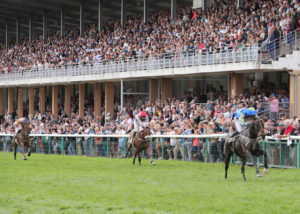
Craon’s Grand Cross, centrepiece of a three day meeting attended by 15,000, is a rare popular exception to sparseley attended meetings in the provinces. ©JCB Photo
The publication of the report has produced a rare unity among racing professionals all now engaged in what they see as a threat to their livelihoods. Meetings have taken place in Sennonnes, Paris, the South-West and among racecourses, owners, trainers and others to date largely unaffected by the changing economics of racing in their country, and for whom this has come as a nasty shock to a sport which thought itself impregnable. The backlash has forced France Galop to widen its consultation.
But whilst no-one wants to see racing stop, there is another body of opinion that believes French racecourses have lulled themselves into a false sense of security, and should have been doing more to grow their own businesses.
In Britain, 50% of racecourse revenues derive from spectators and ancillary spend. The 2m spectators who attend racing in France is less than half the volume over the Channel, they pay little or nothing for entry, and monetizing them whilst on-course is not a priority. There is a cultural change in the offing to commercialize French provincial racing by promoting wider attendance, a more diverse catering offering to remunerate racecourses, and generating sponsorship, which, outside the premium meetings, is next to non-existent.
British racecourses have survived, thrived even, on the value of their customers on track in an environment of diminishing returns from media and static returns from off-course betting. The culture of pre-payment for tickets and hospitality enables stronger fan engagement, encouraging repeat visits and stronger spend on each of those visits. This is way off the reality of a majority of French racing currently.
All is not lost. Some realignment is overdue and necessary. But France Galop’s major challenge is in empowering its provincial base to help themselves, and cease their total reliance upon funds from the centre.
Watch this space. It’s about to get interesting.